
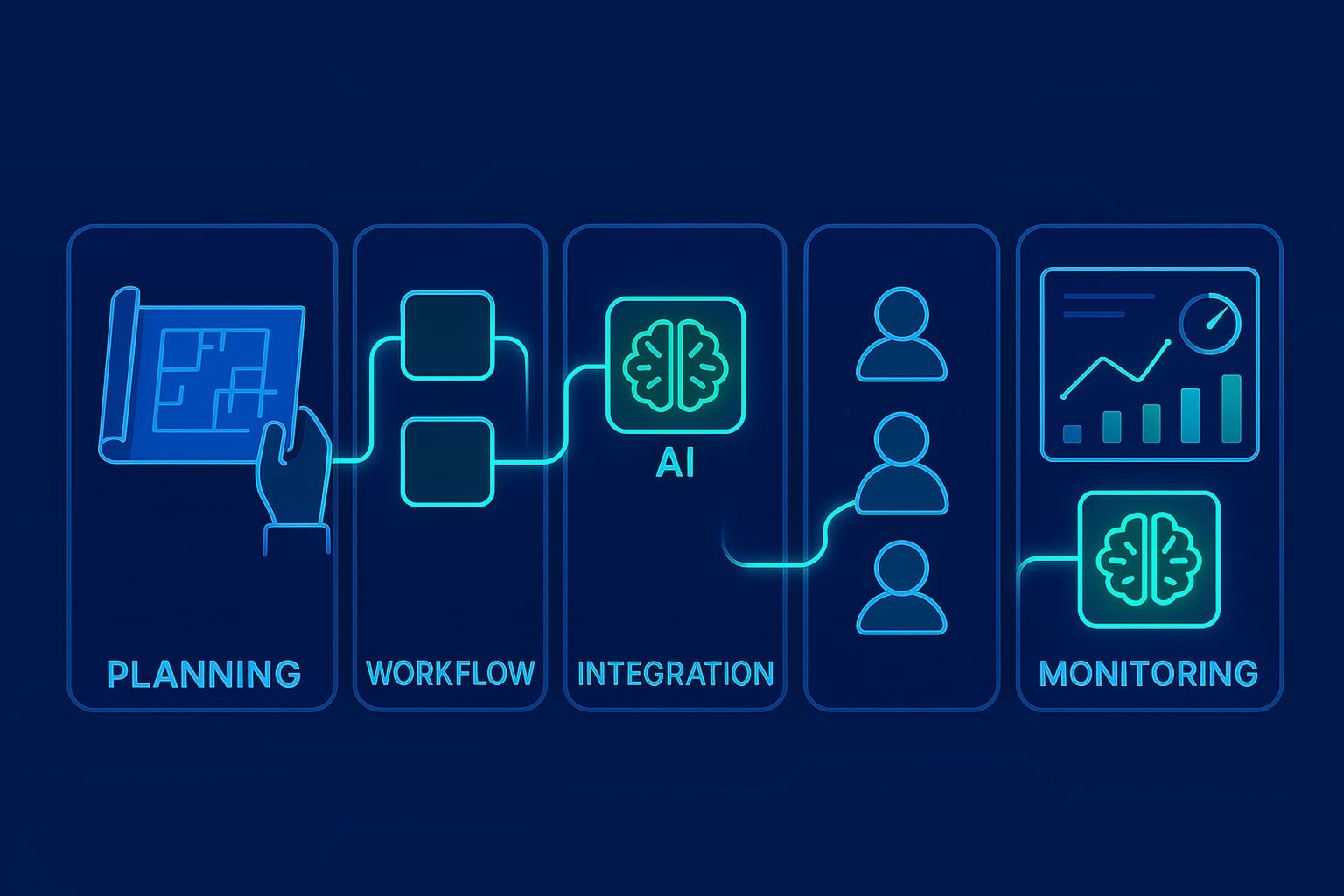
Efficiency is the eternal driver for automation, and yesterday’s rule-based, repetitive systems simply are not enough.
And then there are agentic AI workflows, a revolutionary method of automation that doesn’t just follow instructions but can think for itself, adjust to change, and take action.
Rather than performing a task in a fixed, predetermined way, AI agents’ workflows execute steps by deciding upon them and coordinating them, thereby attaining goals with less or no human involvement.
This innovation is revolutionizing industries by infusing intelligence and autonomy into automation.
What Are Agentic AI Workflows?
At their core, agentic AI workflows are automated systems powered by AI agents that can reason, plan, and act. Agentic workflows are dynamic in contrast to traditional workflows, which are linear and pre-programmed.
They carry out tasks in ways that resemble human problem-solving, adjust to shifting inputs, and learn from outcomes.
Consider an AI agent workflow as a series of clever actions in which the agent gathers information, weighs its alternatives, and decides on the optimal course of action. These agents can work autonomously while cooperating with other agents or human supervisors to handle customer service inquiries or manage a supply chain.
Organizations no longer need to hardcode every situation that may arise because of the transition from static automation to AI agentic processes. The “how” can be figured out by the AI itself.
Core Components of an Agentic Workflow AI
An agentic workflow AI is more than just an algorithm running in the background. It consists of four essential layers that make it intelligent and adaptable:
- Observation and Input
Emails, databases, consumer inquiries, IoT devices, and APIs are just a few of the types of data that the AI consumes.
- Thinking and Making Decisions
Agents evaluate inputs, consider consequences, and choose the optimal course of action using machine learning and natural language processing.
- Action & Execution
The AI does not just recommend, it acts. It can send responses, trigger processes, update systems, or even collaborate with other agents.
- Feedback & Learning Loop
Every action feeds back into the system, allowing the workflow to improve over time and reduce errors.
This continuous loop ensures that AI agent workflows do not stagnate. They evolve, becoming smarter and more efficient with use.
Benefits of Agentic AI Workflows
Adopting AI agentic workflows offers several clear advantages:
- Scalability
Businesses can scale operations without a proportional increase in manpower. AI agents can handle hundreds of tasks simultaneously.
- Effectiveness
End-to-end automation is possible for multi-step procedures that formerly needed several workers.
- Adaptability
AI agents dynamically adjust to new inputs and needs rather than retraining procedures as circumstances change.
- Independence
Workflow configurations for AI agents function with less oversight than those for conventional bots. They can easily coordinate across teams, tools, and procedures.
- Improved Business Results
Lower expenses, quicker turnaround times, and the capacity to concentrate human resources on critical, high-value tasks.
Real-World Applications of Agentic AI Workflows
Real-world applications of Agentic AI Workflows are not theoretical; they are already reshaping industries.
- Client Service
FAQs are maintained by AI agents, who also handle minor problems and only refer complicated instances to human workers. It helps increase customer satisfaction and response times as a result.
- Operations & Finance
Autonomous agents streamline fraud detection, compliance checks, and invoice approvals, which lowers the risk and improves accuracy.
- Medical Care
AI agents can provide diagnostic support, appointment scheduling, and patient monitoring to enhance treatment while cutting down on administrative burden.
- Software Development
AI agents for software development oversee pipelines for code testing, debugging, and deployment, which help engineers concentrate on creativity and have abdunce of free time.
- Sales & Marketing
Every prospect receives the appropriate message in the proper moment, thanks to an AI-driven workflow. This includes lead scoring and tailored email outreach.
On the other hand, businesses must address some challenges on a priority basis. This helps their organizations work smoothly without unexpected risks.
Challenges and Considerations
While the potential is huge, businesses need to consider challenges before adopting agentic workflow AI:
- Data Security & Privacy
Robust security and compliance frameworks are necessary for the responsible handling of sensitive information.
- Trust & Reliability
Decisions made by AI agents must be transparent and explainable to build confidence.
- Integration Complexity
Connecting agents to legacy systems and multiple platforms can be resource-intensive.
- Human Oversight
Human oversight remains critical to preventing errors and ensuring ethical use, even with autonomy.
Building Effective Agentic AI Workflows
Businesses should use the following methodical approach to successfully deploy agentic automation:
- Choose Appropriate Tasks
Autonomy delivers the most value to data-driven, repetitive activities.
- Select the Appropriate Platform
Select AI frameworks or technologies designed for multi-agent cooperation and flexibility.
- Loops for Design Feedback
Ensure that judgments are continually refined and improved through processes based on actual results.
- Build on Ethical Foundations
Create specific guidelines to ensure openness, responsibility, and human-in-the-loop control.
- Scale Gradually
Begin with pilot projects, refine them, then expand into larger workflows.
This systematic approach ensures your AI agent workflow remains reliable while delivering maximum benefits.
Future of Agentic AI Workflows
The next decade will see AI agentic workflows evolve even further. Multi-agent systems, where different AI agents collaborate in real time, will become standard across industries.
The collaboration between human and machine intelligence will innovate work productivity. Businesses that adopt AI agent workflow strategies early will enjoy a competitive edge.
Final Thoughts
Agentic AI workflows are the future of automation. Unlike traditional algorithms, such processes enable AI agents to act, adapt in real-time and run complex tasks without much human supervision. The trick is to act with caution.
That means starting with small tasks where autonomy has the most impact and leaving humans in a loop for strategic oversight.
Automation, of course, has always been about saving time, but with AI agentic workflows, it is also about revealing what’s now possible. Companies that prepare for this future today will be the market leaders of tomorrow.